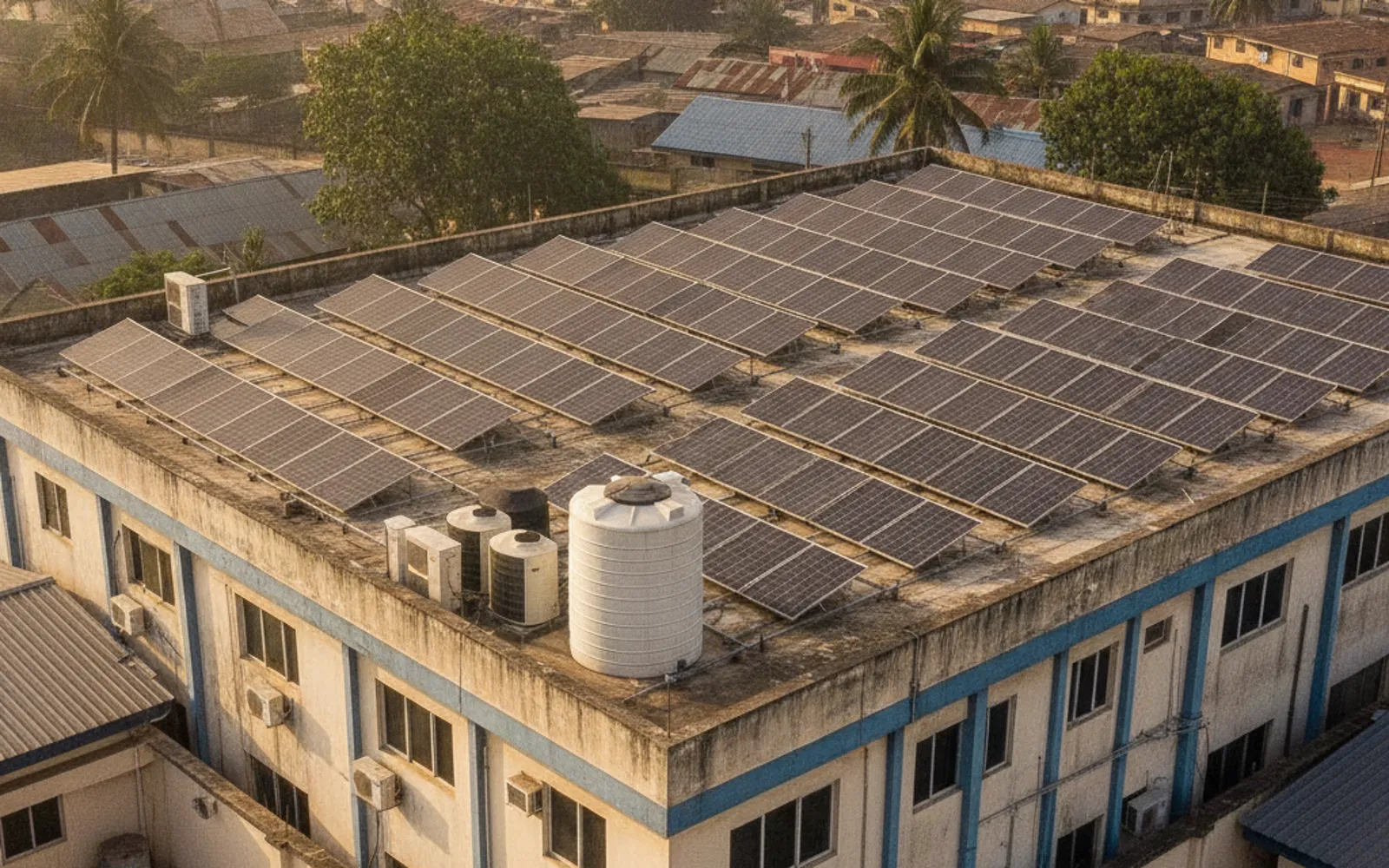
Independent installers audit your load, survey the site and quote a system that names the exact inverter, battery and panel models. Call now to ask for a site survey.
Solar for business means replacing generator hours with panels, an inverter and a battery sized to what your premises actually runs. It covers shops, offices, schools, clinics, churches, filling stations and small factories in Lagos, Abuja, Port Harcourt, Ibadan, Benin City and Enugu. This site installs nothing itself; it puts you in touch with independent installers who quote the job.
The process is the same at any size: a load audit from your rating plates, a site survey for anything bigger than a small shop, then a written quote naming every model. Every price on this page is a published figure from one named source, never our quote, so get two or three comparable written quotes before you commit. Call now on +234 809 000 0000.
The aim is fewer litres of diesel or petrol bought each week, worked out from your own fuel log and the price per litre you pay.
The installer lists every AC, freezer, pumping machine and motor from its rating plate, with the hours each one runs.
Loads that run in daylight draw on panel output directly, so the battery is sized for evenings and outages rather than the whole day.
If your DB is fed three-phase, say so at the start so the quote covers a three-phase hybrid inverter instead of a single-phase one.
Anything above a small shop is quoted after a survey of the roof or ground, the DB, the earthing and the cable routes.
Ask for inverter, battery and panel models, counts, warranty terms and the VAT treatment written down, so two quotes can sit side by side.
Start with what your gen burns, then price the litre. Fuel prices move weekly, so use the price on your last delivery note. For reference, the NBS average diesel price for May 2026 was N3,277.47 per litre, while NaijaNews reported on 10 October 2026 that Dangote raised its diesel gantry price to N1,800 per litre. Those are different measures on different dates, so do not blend them into one figure.
The sum is litres per hour x hours run x price per litre. As a petrol illustration at mid-October 2026 Lagos pump prices (N1,350 to N1,400 per litre, Vanguard, 10-11 October 2026): retailer Jamara Home says a Sumec Firman ECO4990ES runs up to 12 hours at 50% load on a 15 L tank, about 1.25 L an hour (15 / 12). So 1.25 L x 10 hours x N1,400 = N17,500 a day, or N17,500 x 26 = N455,000 over 26 trading days.
That is only one side of the comparison. The other side is the written quote, and we publish no payback period, because it depends on your hours, your load, how often light comes back, upkeep and where the naira goes next. Ask each installer to show their working using your own litres and hours.
If you also pay a NEPA bill, NERC set Band A at N209.50 per kWh from 1 July 2024 in NERC-regulated areas; Lagos retail tariffs are now under LASERC, so check your own bill. If you keep the gen as backup, ask the installer to wire the changeover, and never run a gen indoors or near windows: police suspected generator fumes after six family members died in Eleme, Rivers (Daily Trust, 13 January 2026).
Solar works hardest on loads that run while the sun is up: a shop's AC and lights, a school's classrooms, an office's computers, a church's weekday programmes. Those loads draw on panel output directly, and the battery covers dusk, evenings and the hours when light goes. A business that trades mostly at night needs a bigger battery for each kW of panels.
Here is the scale, as an illustration and not a recommendation. LG lists a 1.5 HP-class inverter split AC (12,000 BTU) at a rated cooling input of 1,090 W, so three of them is 3 x 1,090 W = 3,270 W, and over an 8-hour trading day that is 3.27 kW x 8 = about 26.2 kWh at full rated input. A 9 kW array (20 x 450 W, the panel count in Mercury Direct's listed 11 kVA package) is modelled by PVGIS at 3.83 kWh per kWp per day in Lagos, so 9 x 3.83 = about 34.5 kWh on an average day and 9 x 2.89 = about 26.0 kWh on a July day. Real draw varies and the rest of the premises adds to it, which is why a survey comes first.
To get a usable quote, have these ready for the installer:
Your DB and the supply feeding it decide whether a single-phase or a three-phase hybrid inverter fits, so premises with three-phase motors should say so at the first call. On 14 October 2026 Zit (zit.ng) listed a Deye 8 kW three-phase hybrid inverter at N2,627,750 and a Deye 12 kW three-phase unit at N3,020,000. Those are inverter-only prices, with no battery, panels or labour.
Full-system listings show how far contents differ. In October 2026 Mercury Direct listed an 11 kVA hybrid with 15 kWh of lithium and 20 x 450 W panels at N9,538,000, and SMK Solar listed an 11 kVA system with 18 kWh of lithium and 12 x 600 W panels at N5,939,000. BusinessDay (17 February 2026) put commercial systems of 10 kW and above at N10 million to N50 million or more, and SustifyHomes (August 2026) put a 10 kVA hybrid at N7 million to N12 million. None of these is our quote, and prices move with the naira.
Larger systems are quoted after a site survey, not from a phone call. NEMSA guidelines as reported in April 2026 list the checks a competent installer works through:
Ask every installer to write the following into the quote, so a buyer or a finance officer can compare like with like:
Ask for the installer's NEMSA competency certificate and look the name up in NEMSA's directory (nemsa.gov.ng/directory/) or on its verification page (nemsa.gov.ng/verification/). Industry experts quoted by NAN (via Peoples Gazette, 8 July 2026) say batteries, inverters, panels, charge controllers and cables are the most counterfeited items, so check serial numbers, QR codes and warranty papers, and buy from authorised dealers. Keep every receipt, since the Federal Competition and Consumer Protection Act 2018 gives a right to return goods that do not match the agreed specification (s 122, as quoted by Templars, June 2025).
Then plan upkeep. SustifyHomes, a quote marketplace, listed a maintenance visit at N25,000 to N60,000 in its August 2026 home guide, covering panel cleaning, torque checks, firmware and a health report; a larger business array may differ. A Maiduguri field test found more than 50% loss in power output after 14 days of continuous dust deposition and advised weekly cleaning in intense dust, but no measured figure exists for the six cities we cover, so ask the installer to write down the visit schedule and the cleaning plan. For a system that already trips, see solar and inverter repair.
BusinessDay (17 February 2026) put commercial systems of 10 kW and above at N10 million to N50 million or more, and said professional installation alone runs N150,000 to N800,000. In October 2026 Mercury Direct listed an 11 kVA package with 15 kWh of lithium at N9,538,000, and SMK Solar listed an 11 kVA package with 18 kWh of lithium at N5,939,000. Contents differ and prices move with the naira, so the only real number is a written quote after a site survey. See the price guide for dated figures.
Work out your own daily fuel bill first: litres per hour x hours x price per litre. At mid-October 2026 Lagos pump prices, a gen burning about 1.25 L an hour for 10 hours uses 1.25 x 10 x N1,400 = N17,500 of petrol a day. We publish no payback or savings figure, because they depend on your hours, load and the naira, so ask installers to run the sum on your own fuel log.
Not at shop or office scale. NERC's Net Billing Regulations 2026 start at a renewable system of 50 kWp, with DisCo approval, a bidirectional meter and an export tariff still to be determined by NERC. A 9 kW array is far below that, so size the system for your own use.
For anything above a small shop, yes, because larger systems are quoted after a survey of the roof or ground, the DB and the earthing. NEMSA guidelines as reported in April 2026 put a load assessment first. Have your rating plates, a month of fuel notes and your DB type ready, since a 5 kVA inverter at 0.8 power factor carries only 4 kW of real load and the installer needs your real kW.
Ask for their NEMSA competency certificate and look them up at nemsa.gov.ng/directory/. Industry experts quoted by NAN on 8 July 2026 say fake batteries and inverters are the biggest fire risk, so check serial numbers, QR codes and warranty papers. Get warranty terms in writing; Deye's official terms (v1.7, 2023) say 5 years, with 10 optional, from the date of installation.
Written quotes from independent Nigerian solar installers.