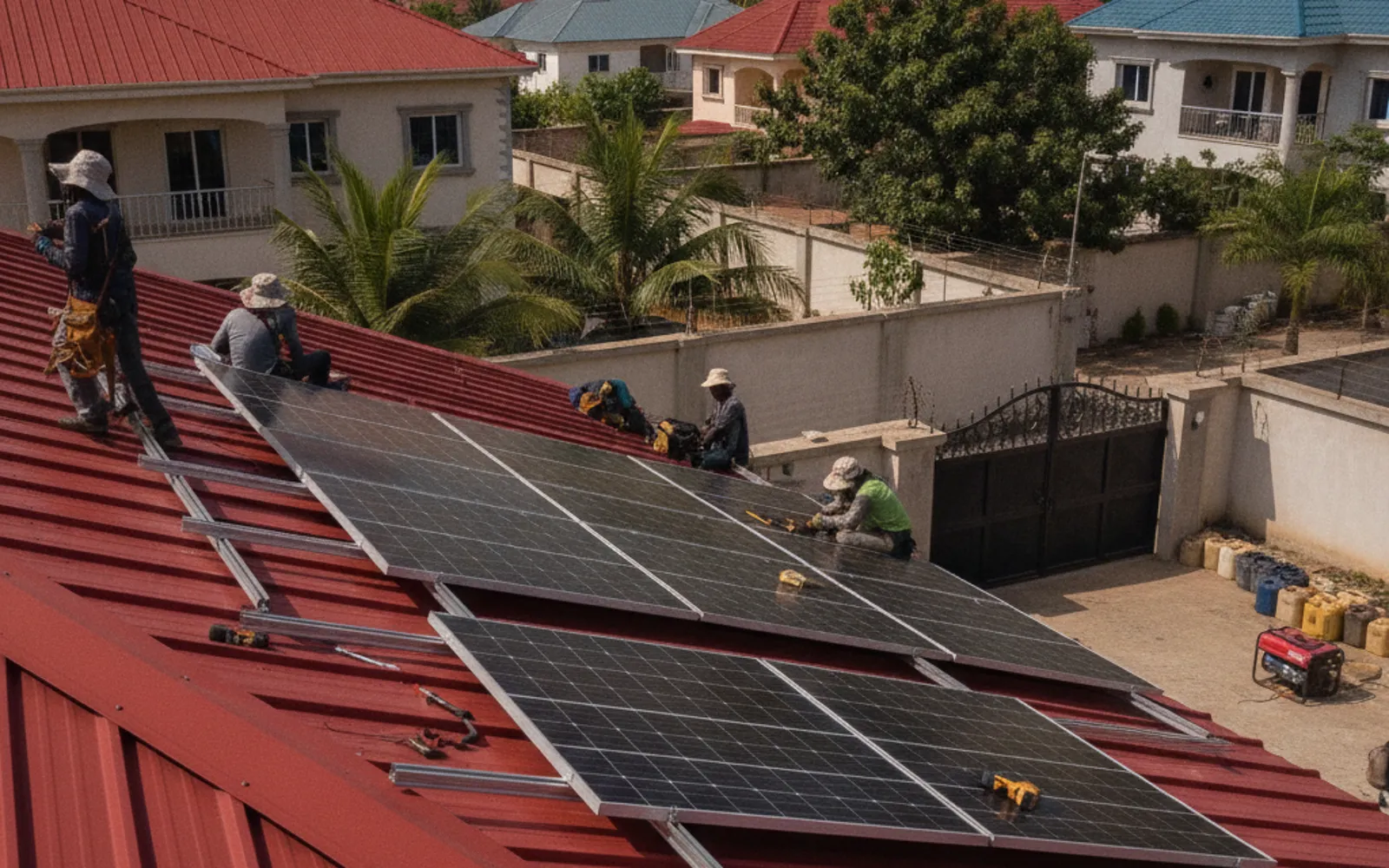
How an independent installer sizes a hybrid system for your flat, bungalow or duplex, what the quote should list, and how to compare two quotes line by line.
Solar for home usually means one package: a hybrid inverter, a battery bank and rooftop panels, wired to your distribution board so the house can run from panels and battery before it falls back on the NEPA line or the gen. The work is done by an independent installer, not by this site, and a sound job starts with a load audit of what you actually run: fridge, freezer, fans, TV, pumping machine and, in some homes, AC.
Published price guides cover home systems from 1 kVA up to about 10 kVA, and the right size follows your appliances, not the size of your house. This page covers how sizing is done, what a complete package lists, roof mounting and changeover wiring, and how to compare quotes. Call now on +234 809 000 0000 and describe your appliances, and you will be pointed to an independent installer who can quote.
Sizing starts from the rating plates on your fridge, freezer, fans, TV, pumping machine and AC, not from a rule of thumb.
Mercury Direct's listings run from 1.5 kVA up to 11 kVA. The kW figure on the inverter datasheet is what it can actually carry.
Mercury Direct's lithium packages run from 5 kWh to 15 kWh; tubular banks are quoted by the number of 220Ah batteries. Chemistry and capacity must be on the quote.
Panels sit on mounts fixed to your roof structure. On aluminium or long-span roofs, ask what the mounts fix to before the job starts.
Chosen circuits move between light, inverter and gen through a changeover or ATS, with isolators, breakers, surge protection and earthing.
Two or three comparable written quotes, each listing the exact inverter, battery and panel models, is how you avoid paying for a swap.
A proper quote starts with a load audit. The installer lists every appliance you want covered, reads the rating plate on each one and asks which run at the same time. This page does not print typical wattages for fans, TVs, freezers, fridges or pumping machines, because they differ by model; the plate on your own appliance is the number that counts.
AC is where sizing jumps. LG lists a 1 HP-class 9,000 BTU inverter split at 1,000 W rated cooling input, and a 1.5 HP-class 12,000 BTU unit at 1,090 W rated and 1,350 W maximum. Also remember that kVA is not kW: real power equals apparent power times power factor, so a 5 kVA inverter at 0.8 power factor carries 4 kW of real load. Read the kW figure on the inverter's own datasheet.
Next comes energy. The kWh your house uses between evening and morning decides battery size, and daily use decides panel count. PVGIS modelling puts Lagos at about 3.83 kWh per kWp per day on average, so 3.6 kW of panels gives about 13.8 kWh a day on average (3.6 x 3.83) and about 10.4 kWh on a July day (3.6 x 2.89), before dust. That is an illustration of the arithmetic, not a promise of what your roof will produce.
The other side of the sum is the gen. Nigerian retailer Jamara Home lists a 3.0 kVA Sumec Firman ECO4990ES with a 15 L tank running up to 12 hours at 50% load, about 1.25 L an hour (15 / 12). Five hours at N1,400 a litre (Lagos pump price, 10 to 11 October 2026, Vanguard) is 1.25 x 5 x N1,400 = N8,750 a day in petrol, an illustration at mid-October 2026 Lagos pump prices.
Price guides cover home systems from 1 kVA to 10 kVA. BusinessDay (17 February 2026) put 1 to 2 kVA systems at N850,000 to N1.2 million, 3 to 4 kVA at N2 million to N3 million and 5 to 8 kVA at N3.5 million to N5.5 million. SustifyHomes (prices updated August 2026) listed a 10 kVA system at N7 million to N12 million. These are press and guide ranges, not quotes from this site.
Here is what named sellers listed in October 2026, with what each package contains:
Naira prices move with the exchange rate. Mobility.com.ng (June 2026) noted that a panel at N120,000 can reach N140,000 a month later purely on currency moves, so treat every figure here as a dated sighting and ask for a current written quote.
A complete package should list the hybrid inverter, battery bank (with a battery management system if lithium), panels, mounts, DC and AC isolators, breakers or fuses, surge protection, earthing, cables in conduit and the changeover or ATS. Whether labour is in the price differs by seller: BusinessDay put professional installation alone at N150,000 to N800,000.
Panels are fixed to mounts on your roof structure. NEMSA guidelines as reported in April 2026 call for a sound roof and mounts, so a good quote says how the mounts fix to your roof type, whether that is aluminium, long-span sheeting or concrete, and whether the roof needs checking first. Ask for that in writing instead of leaving it to the day of the job.
At the DB, the installer decides which circuits the inverter feeds. Some homes put lights, fridge, freezer, fans, TV and sockets on the inverter and leave heavy loads such as AC or the pumping machine on the gen or grid side, unless the system is sized to carry them. A changeover or ATS is what moves those circuits between light, inverter and gen, and your quote should say which circuits it covers.
NEMSA guidelines as reported in April 2026 say rooftop solar PV must be installed only by NEMSA-certified electrical contractors, with the competency certificate on site, DC and AC isolators, breakers or fuses, surge protection, earthing, batteries ventilated and away from living areas, lithium batteries with a battery management system, and cables in conduit. NEMSA publishes a directory of certified contractors and a verification page at nemsa.gov.ng, so ask for the certificate and look the installer up.
Whatever system you choose, never run a gen indoors or near windows. Daily Trust reported on 13 January 2026 that six family members died in Eleme, Rivers, and police suspected generator fume poisoning.
Put the quotes side by side and compare like with like. Each should name the exact inverter model and its kW rating, battery chemistry and kWh, panel count and watts, mounts, protection devices, the changeover, and whether installation, delivery and VAT are included. For example, Mercury Direct's 3.5 kVA package lists 8 x 450 W panels (3.6 kW) while SMK Solar's lists 6 x 450 W (2.7 kW), so part of the price gap is simply fewer panels.
Compare warranty terms the same way, and ask who honours them in Nigeria:
Fakes are a real worry. Industry experts quoted by NAN in July 2026 say fake batteries and inverters are the biggest fire risk, and advise checking the manufacturer, serial numbers, QR codes and warranty papers and buying from authorised dealers. The Federal Competition and Consumer Protection Act 2018 gives a right to return goods that do not match the agreed specification (s 122, as quoted by Templars, June 2025), so get the models, warranty and VAT treatment written on the quote and keep every receipt.
The honest route is two or three comparable written quotes. Call now on +234 809 000 0000 and an independent installer can price your load audit.
Published October 2026 package prices from Lagos sellers put a 3.5 kVA lithium system with panels at roughly N3.1 to N3.4 million, and a 5 kVA-class system with 10 kWh of lithium and panels at about N5 to N5.5 million. For example, SMK Solar listed N3,121,000 and Mercury Direct N3,400,000 for 3.5 kVA packages. These are seller listings, not quotes from this site, and prices move with the naira, so ask for a current written quote.
Your appliances decide it, not the house type. BusinessDay (February 2026) grouped 1 to 2 kVA systems at N850,000 to N1.2 million, 3 to 4 kVA at N2 million to N3 million and 5 to 8 kVA at N3.5 million to N5.5 million. A 5 kVA inverter at 0.8 power factor carries 4 kW of real load, so read the kW figure on the datasheet. An installer reads your rating plates in a load audit before suggesting a size.
On manufacturer figures, the Felicity LPBF48100-A (5 kWh LiFePO4) manual states 6,000 cycles at 80% depth of discharge, while the Luminous LPT 1240H tubular page states up to 1,500 cycles at 80%, about 4 times as many, each on its maker's own test conditions. BusinessDay (February 2026) says lead-acid batteries last only three to five years. Mercury Direct listed a 5 kWh lithium battery at N1,150,000 and a 220Ah tubular at N260,000 in October 2026, but they hold different amounts of energy, so compare on a written quote.
It depends on the size of the system. LG rates its 1 HP-class 9,000 BTU inverter AC at 1,000 W cooling input and its 1.5 HP-class 12,000 BTU unit at 1,090 W, up to 1,350 W. Add that to everything else running at the same time and check it against the inverter's kW (a 5 kVA unit at 0.8 power factor carries 4 kW) and the battery. Ask the installer to put the AC in the load audit and state in writing what the system is sized to carry.
There is no scheme for a typical home. NERC's Net Billing Regulations 2026, announced in June 2026, start at a renewable system of 50 kWp, with DisCo approval, a bidirectional meter and an export tariff still to be set by the Commission. A home system is far below that size, so plan the system around your own use and your NEPA bill or gen fuel.
Written quotes from independent Nigerian solar installers.