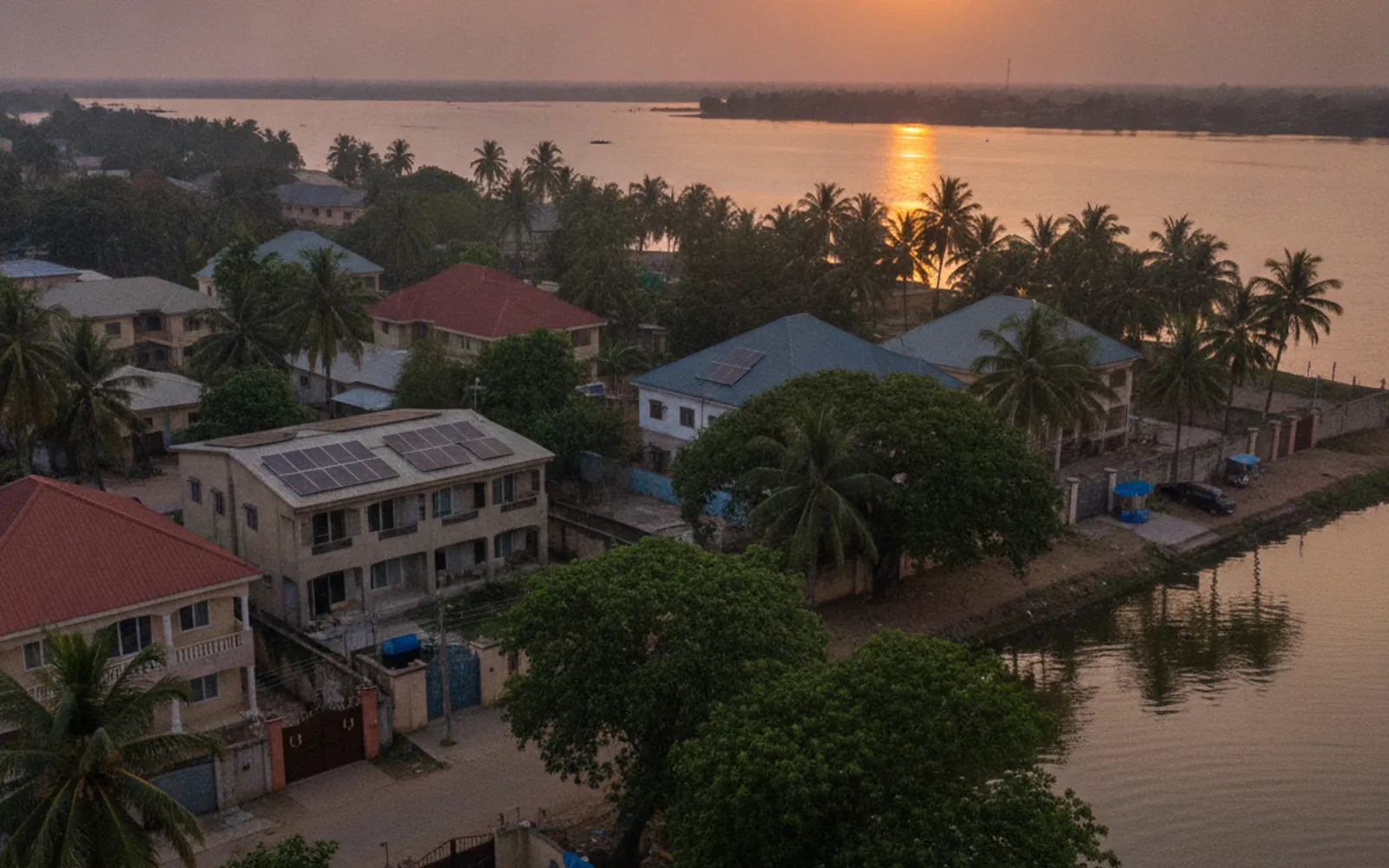
From Ikeja and Yaba on the Mainland to Lekki and Ajah on the Island, get two or three comparable written quotes from independent installers. Call now and ask for quotes that name the exact inverter, battery and panel models.
Solar installation in Lagos usually starts with the same problem: light that comes and goes, and a gen that eats petrol to cover the gaps. As an illustration, a 3.0 kVA generator running about 5 hours a day at about 1.25 litres an hour (Nigerian retailer Jamara Home says the Sumec Firman ECO4990ES runs up to 12 hours at 50% load on a 15 L tank, and 15 / 12 = 1.25) and petrol at N1,400 a litre (a Lagos pump price reported by Vanguard on 10-11 October 2026) costs 1.25 x 5 x 1,400 = N8,750 a day. That is an example, not a prediction for your house.
This site is advertising for independent Nigerian solar installers. It does not install or sell anything itself. Call now with your area and what you want to run, and ask for an independent installer to send a written quote you can compare with two others.
Hybrid inverter, battery and panels for duplexes and flats in Ikeja, Surulere, Yaba, Lekki and Ajah estates. The installer should work from a load audit of your own appliances.
For Lagos homes whose old inverter and tubular batteries no longer last the night. Ask for lithium and tubular options quoted side by side, with the exact battery model on paper.
For shops, schools, clinics, churches and small offices from Ikorodu to Festac that want to cut diesel. Ask for the load assessment and the changeover arrangement in writing.
For a system that keeps tripping or a battery bank that has gone weak. An installer should check wiring, protection and settings before blaming the equipment.
Lagos is served by Ikeja Electric in the north and west and by Eko in the south, and both are now licensed by the Lagos State Electricity Regulatory Commission (LASERC), which took over retail tariffs on 4 June 2025. Light is sold in bands by minimum hours of supply: Band A is 20 hours a day, B is 16, C is 12, D is 8 and E is 4 (NERC Order 2025/064). A LASERC official quoted Band A at N209.50 per kWh in September 2026 and said LASERC is designing a Lagos-specific tariff methodology, so check your own bill and your regulator before you work out any comparison.
Bands B to E are frozen at December 2022 rates and differ by DisCo, so there is no single Lagos figure to quote. Government statements in July and September 2026 said no grid tariff rise was planned, but that can change, and nobody should promise you a future price.
One more point for Lagos homeowners: there is no scheme for a typical home to sell power back to the grid. NERC's Net Billing Regulations 2026 start at 50 kWp, far above a home system, so size your system for your own use. For the price side, read the solar system price guide.
A duplex in an Ikeja or Lekki estate often has a roof the owner controls, so the question is where the panels will sit and how the cables run. In a block of flats in Surulere, Yaba or Festac, roof space is shared and limited. Ask the installer who they will agree the roof position with, and ask for the panel count and layout on the quote.
Lagos sits on the coast and around the lagoon, so ask the installer how mounts, fixings and cable terminations are protected against corrosion. This site holds no measured figure for it, so treat it as a question to put to the installer, not a number.
On output, PVGIS-SARAH2 modelling puts Lagos at about 1,396 kWh per kWp per year, or 3.83 kWh per kWp a day. As an illustration, 3.6 kW of panels (eight 450 W panels) averages about 3.6 x 3.83 = 13.8 kWh a day, and about 3.6 x 2.89 = 10.4 kWh on a July day, because the rainy months are the weakest (February is the best month at 4.56 kWh per kWp a day). These are model figures before dust soiling, and no measured soiling figure exists for Lagos.
Published October 2026 package prices from Lagos sellers put a 3.5 kVA lithium system with panels at roughly N3.1 to N3.4 million. Mercury Direct listed a 3.5 kVA hybrid with 5 kWh LiFePO4 and eight 450 W panels, installation included, at N3,400,000, and SMK Solar listed a 3.5 kVA with 5 kWh lithium and six 450 W panels at N3,121,000 (its page lists installation accessories, so do not assume labour is included). Naira prices move with the exchange rate, so a current written quote is the real number. BusinessDay (17 February 2026) put professional installation alone at N150,000 to N800,000.
Compare like with like: battery kWh, panel count and whether installation is in the price. Ask for the exact inverter, battery and panel models, the warranty terms and the VAT treatment written on the quote, and keep your receipts. NEMSA guidelines as reported in April 2026 say rooftop solar must be installed by NEMSA-certified electrical contractors, so ask the installer for their competency certificate and look them up in the directory at nemsa.gov.ng/directory/.
Industry experts quoted by NAN in July 2026 say fake batteries and inverters are the biggest fire risk, so check serial numbers, QR codes and warranty papers. For business owners, see commercial solar, and for ageing batteries see inverter and battery installation. Call now on +234 809 000 0000 and ask for an independent installer to quote your job.
It depends on the system size, battery type and what is included. As listed in October 2026, Mercury Direct had a 3.5 kVA lithium package with panels at N3,400,000 and SMK Solar had a 3.5 kVA, 5 kWh lithium package with six 450 W panels at N3,121,000 (labour not confirmed), while Mercury Direct's 5.5 kVA package with 10 kWh lithium and sixteen 450 W panels was N5,538,000. Prices move with the naira, so get two or three current written quotes.
BusinessDay (February 2026) says lead-acid batteries last only three to five years. The Felicity LPBF48100-A manual states 6,000 cycles at 80% depth of discharge, and the Luminous LPT 1240H tubular page states up to 1,500 cycles at 80%, which is 4 times as many cycles on each maker's own test conditions. Ask installers to quote both and name the exact battery model.
It depends on your appliances, so ask the installer for a load audit from the rating plates on your own appliances. One published reference point: an LG 9,000 BTU inverter split AC lists a rated cooling input of 1,000 W. At a 0.8 power factor a 3.5 kVA inverter carries about 2.8 kW of real load (3.5 x 0.8) and a 5 kVA about 4 kW, so read the kW figure on the datasheet.
Ask for their NEMSA competency certificate and look them up on the NEMSA Directory of Certified Electrical Contractors at nemsa.gov.ng/directory/ or the verification page at nemsa.gov.ng/verification/. Get the models, warranty and VAT treatment written on the quote. Under the Federal Competition and Consumer Protection Act 2018, goods that do not match the agreed specification can be returned for a refund.
Written quotes from independent Nigerian solar installers.